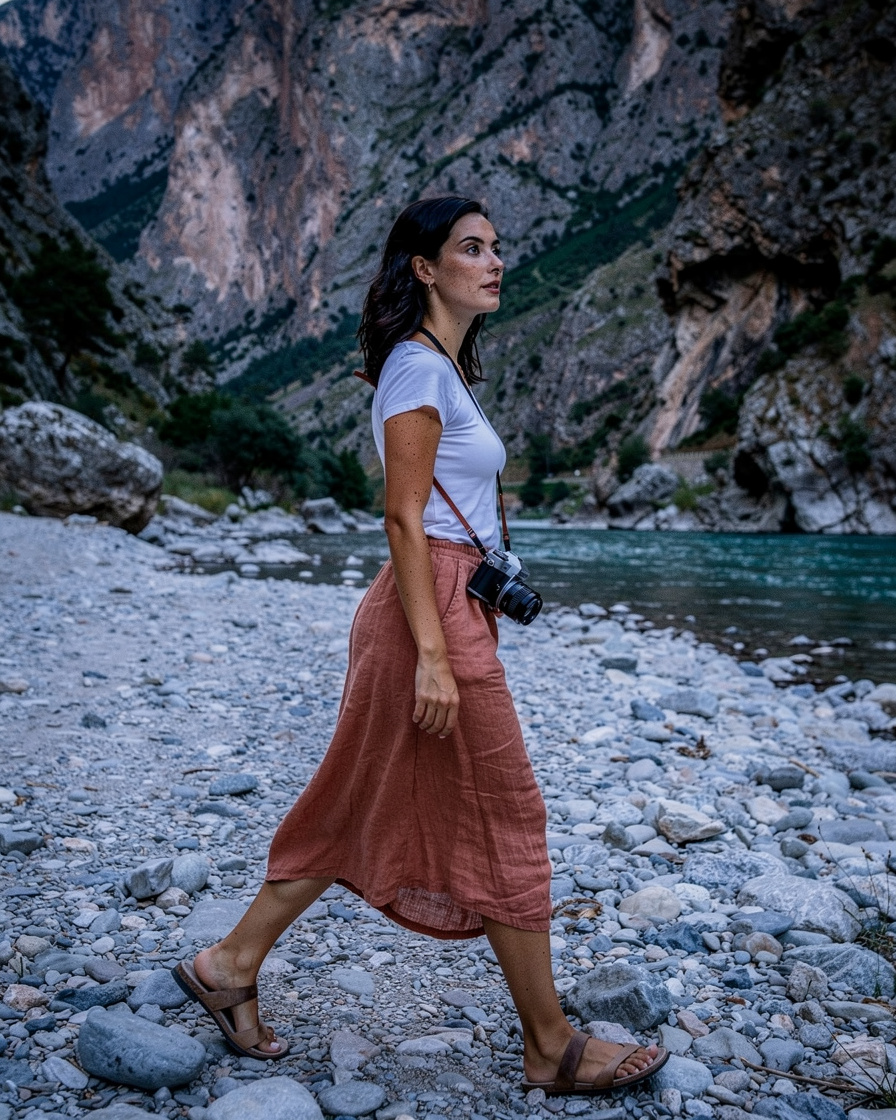
I started before the sun could reach the bottom. That is the thing about gorges. The sky is up there, doing its work, throwing pinks and golds around, and you are down here in yesterday's temperature. The walls are pale limestone streaked with iron, close enough in some stretches that I could press both palms flat and touch each side. My footsteps on the pebbles sound ridiculous, too loud, like I am interrupting a conversation between very old things.
The riverbed is dry. It will not run again until autumn, but the cold air still carries the memory of water, something mineral and clean that sits at the back of your throat. Cypress trees cling to cracks in the rock far above me, stubborn, almost funny in their determination. I stopped to load a new roll and my fingers were stiff. The camera felt heavier than usual, or maybe I was just more aware of carrying anything at all in a place that has been slowly emptying itself for fourteen million years.
There were a few other hikers behind me, voices bouncing off the walls in a language I could not place, but I had enough distance to feel alone. That is the trick with popular trails. You wake up earlier than your own comfort allows and you buy yourself an hour of solitude. It is a fair trade. I kept thinking about my grandfather, my mother's father, who worked in a marble quarry outside Carrara before he moved to Brazil. He would have understood this scale. He would have looked at these walls and seen work, not scenery.
At the narrowest point, the Portes, the walls squeeze to about three meters apart and the light drops to almost nothing. I shot two frames there, knowing the exposure would be a guess. Sometimes guessing is the photograph. Sometimes you just stand in a crack in the earth and let the cold press against your skin and that is enough. I do not know what I expected to feel. Small, probably. I felt small. It was a relief.