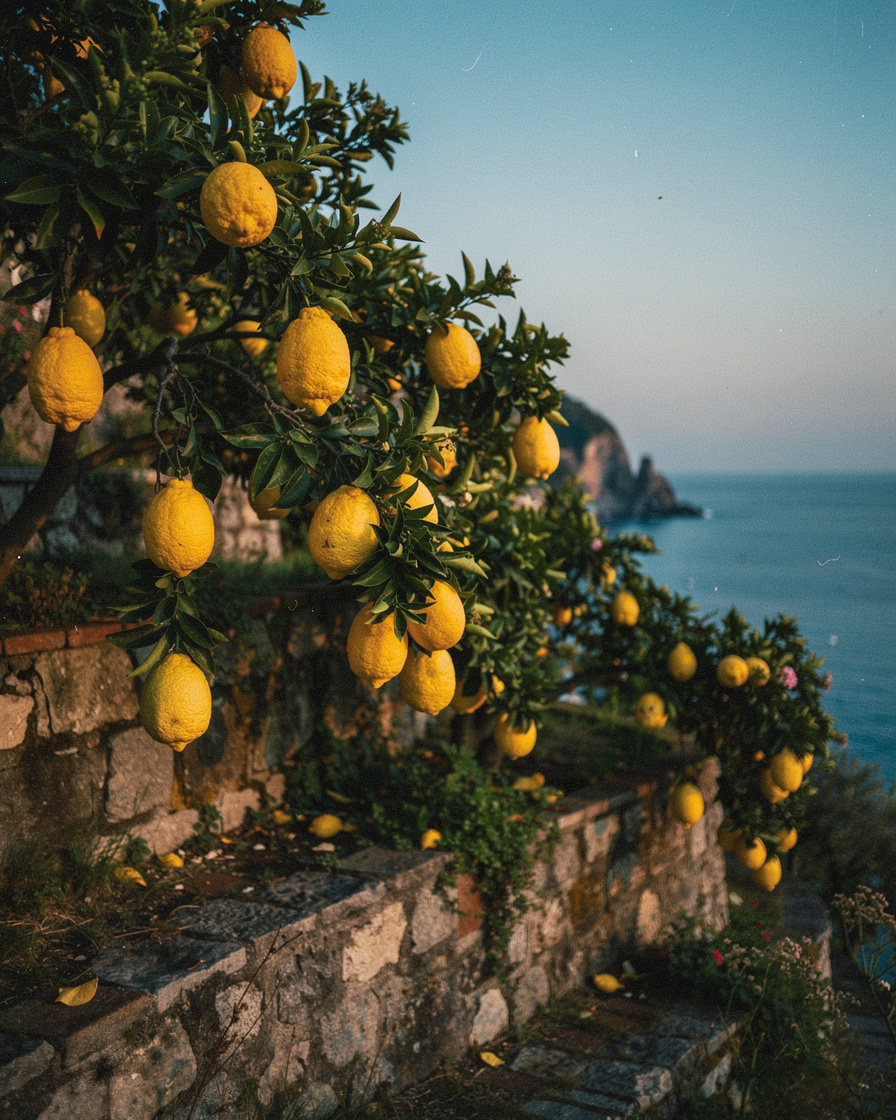
The terraces here were built by people who understood patience. Stone walls stacked by hand, soil carried up in baskets, lemon trees planted in rows that follow the curve of the mountain. Centuries of that. And now the fruit just hangs there, ridiculous in size, skin thick and knobbly, so yellow it almost hums. I press my thumb into one and the oil beads up instantly. The smell is not subtle. It fills your throat.
I came up from the road around seven, when the light was already doing its thing. That hour where everything turns to honey. The camera caught it before I could think about it. Click. The Sfusato lemons, the cracked wooden supports holding up the branches, the nets stretched between poles to catch whatever falls. Below, very far below, the sea was going from blue to copper. No boats. No sound except the leaves and something, maybe a gecko, moving through dry brush.
My father's mother kept a single lemon tree on her balcony in Milan. One of those small ornamental ones that barely produced anything worth eating. But she would stand next to it every evening and touch the leaves like she was checking on a friend. I never understood that until now. There's something about a lemon tree that asks you to stay close.
I sat on the low wall at the edge of the terrace and let the camera rest in my lap. The film roll was almost done, two frames left, and I didn't want to waste them on something I could not feel yet. So I just sat. The gold faded slowly. The air cooled. The smell of the lemons stayed, thick and present, mixing with salt from below. Someone far off was closing a shutter for the night. Profumo di casa. That was the whole evening. That was enough.