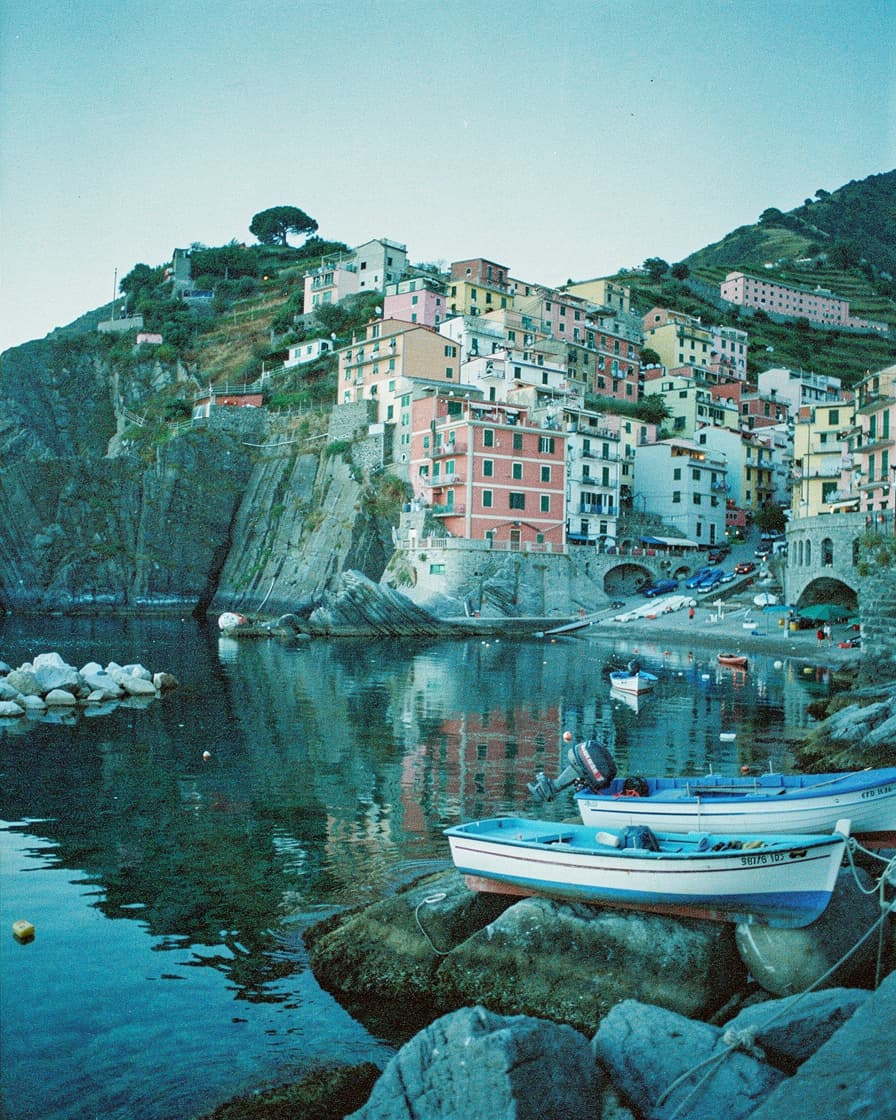
I set an alarm for something unreasonable. Left the room while the hallway was still dark and the stone steps outside were cold under my sandals. Manarola at this hour is not the Manarola you’ve seen in other people’s photos. There are no crowds lining the rocks with selfie sticks, no voices bouncing off the cliff face. Just water. Just color. Just the faint knock of a fishing boat against the harbor wall.
The houses looked unreal. Pink, ochre, a faded terracotta that reminded me of my nonna’s kitchen tiles in Brera. Every shade doubled in the water below, so precise it was hard to tell which version was the built one and which was the dream. I loaded a fresh roll. Fuji 400. Knelt on the stone ramp where the fishermen drag their boats and waited for the light to finish arriving. It took its time. The camera clicked once, twice. I didn’t rush a third.
There’s a particular silence that only exists in coastal towns before the day begins. Not empty silence. Full silence. You can hear the water breathing against the rocks, the creak of old rope, a gull testing its voice from somewhere above. Salt and wet stone and, faintly, coffee from a kitchen window I couldn’t see. I thought about São Paulo mornings, the traffic already roaring at six, my mother yelling over the blender. Two lives, two speeds. I keep choosing the slower one.
I sat on the ramp for maybe forty minutes. A cat appeared, considered me, left. An old man in rubber boots walked past without looking at the view, which felt like the most honest thing I’d seen in weeks. He lives inside the postcard. It means nothing to him. I envied that, briefly, then let it go. The light shifted. The mirror in the harbor started to break apart. I capped the lens. Some mornings you only need two frames.