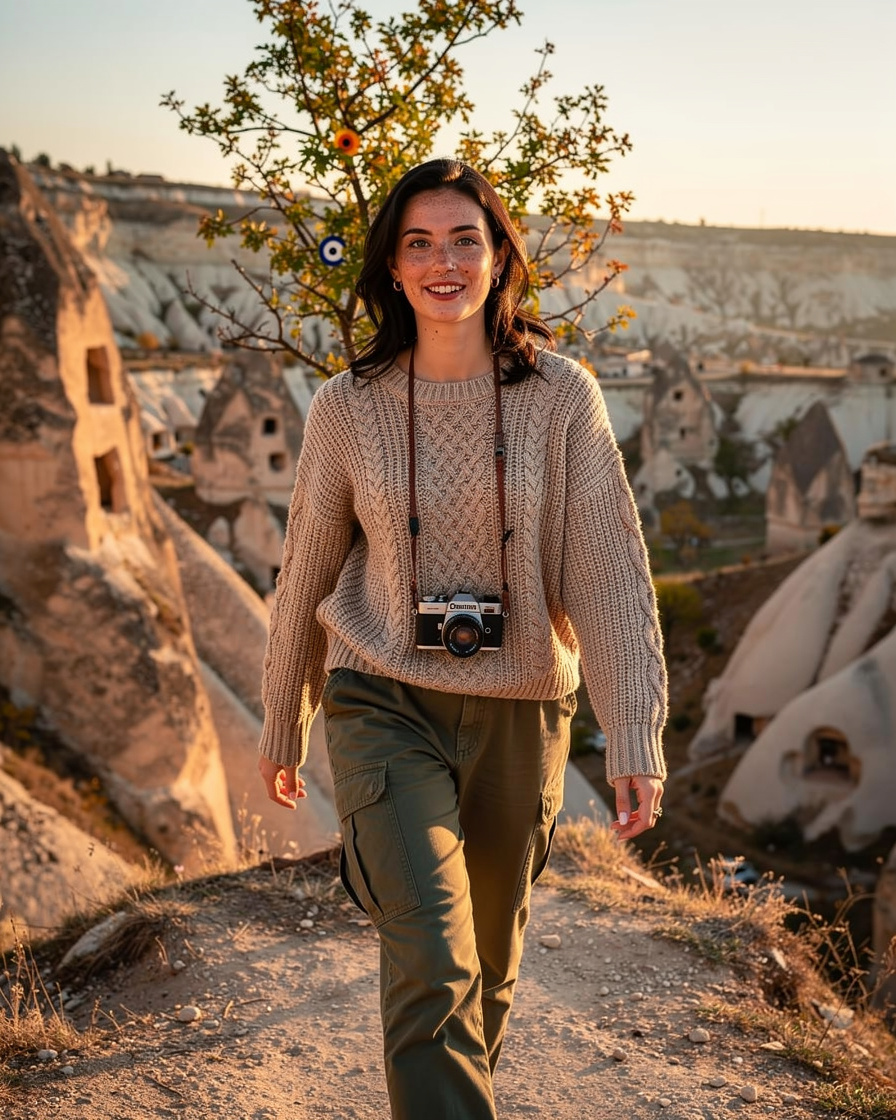
Sixteen-oh-two and the wind has an opinion about everything. It pushes at the duffel strap on my shoulder, pulls grit across the path, moves through the bare tree at the lookout so the evil-eye charms knock against each other like small blue bells. Nobody put them there for me. Somebody did, though. That's the part I keep circling back to.
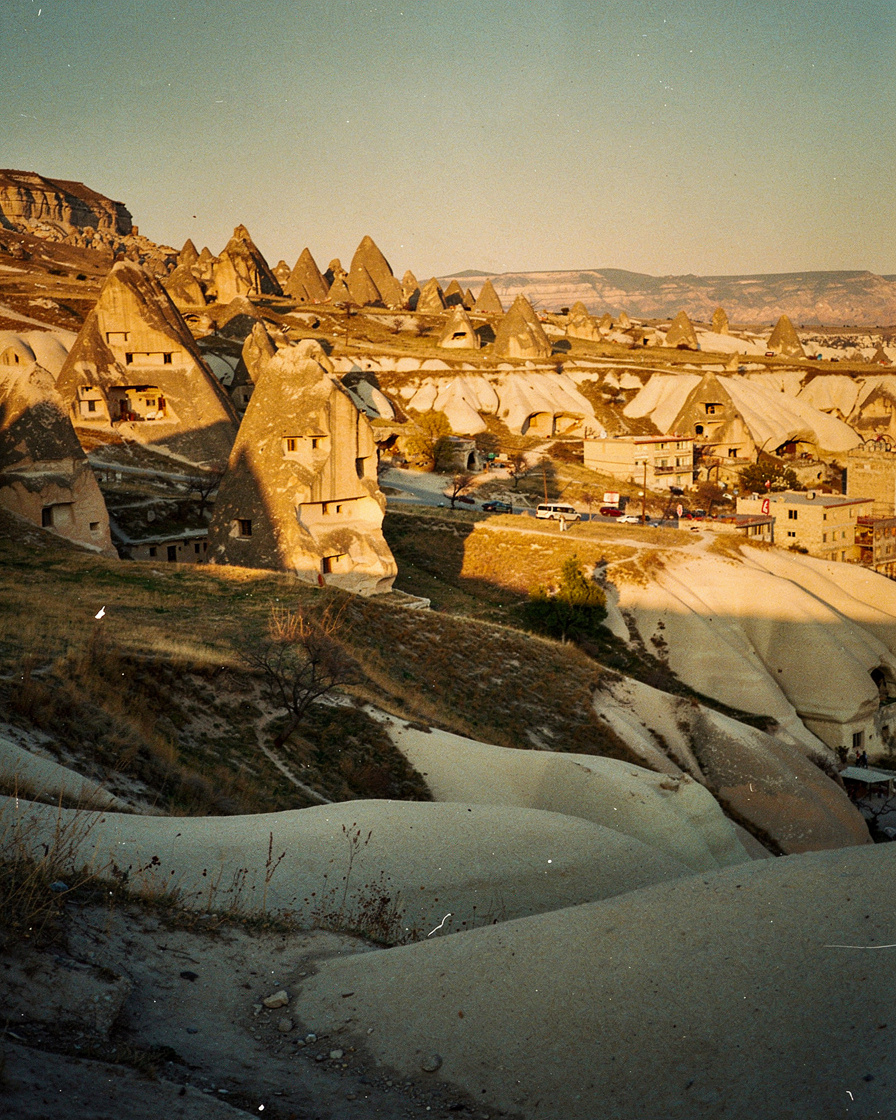
Below the ridge, Pigeon Valley opens up soft and pale, cut through with what must be thousands of dovecotes, hollowed by hand into rock the color of old bread. From here they look like punctuation, a whole paragraph of holes waiting for something to land. Once this was a working system, farmers trading grain for guano, pigeons doing quiet labor nobody thanks them for anymore. Now it's mostly wind and tourists and me, trying to get the light before it turns.
The camera hangs against my chest, patient, the way it always is. I haven't lifted it in ten minutes. Some places make you want to shoot everything. This one makes me want to just stand here first, let the dust settle into my shoes, let the valley do its slow erosion in front of me the way it has for a few million years, unbothered by whether I show up or not.
There's a family further down the path, kids running ahead, a grandmother moving slower, hand trailing the low stone wall like she's reading it in braille. Nazar charms clink again behind me. Somewhere in Sao Paulo my mother has one nailed above her door, half superstition, half habit. Funny, the things that travel with people even when the people don't move much at all.
I take the shot eventually. Wide, ridge line low in the frame, valley doing the heavy lifting. The film won't catch the wind, or the smell of dust and something faintly mineral, or the sound the charms make. That part stays here, with me, unrecorded. Maybe that's fine. Not everything needs a copy.