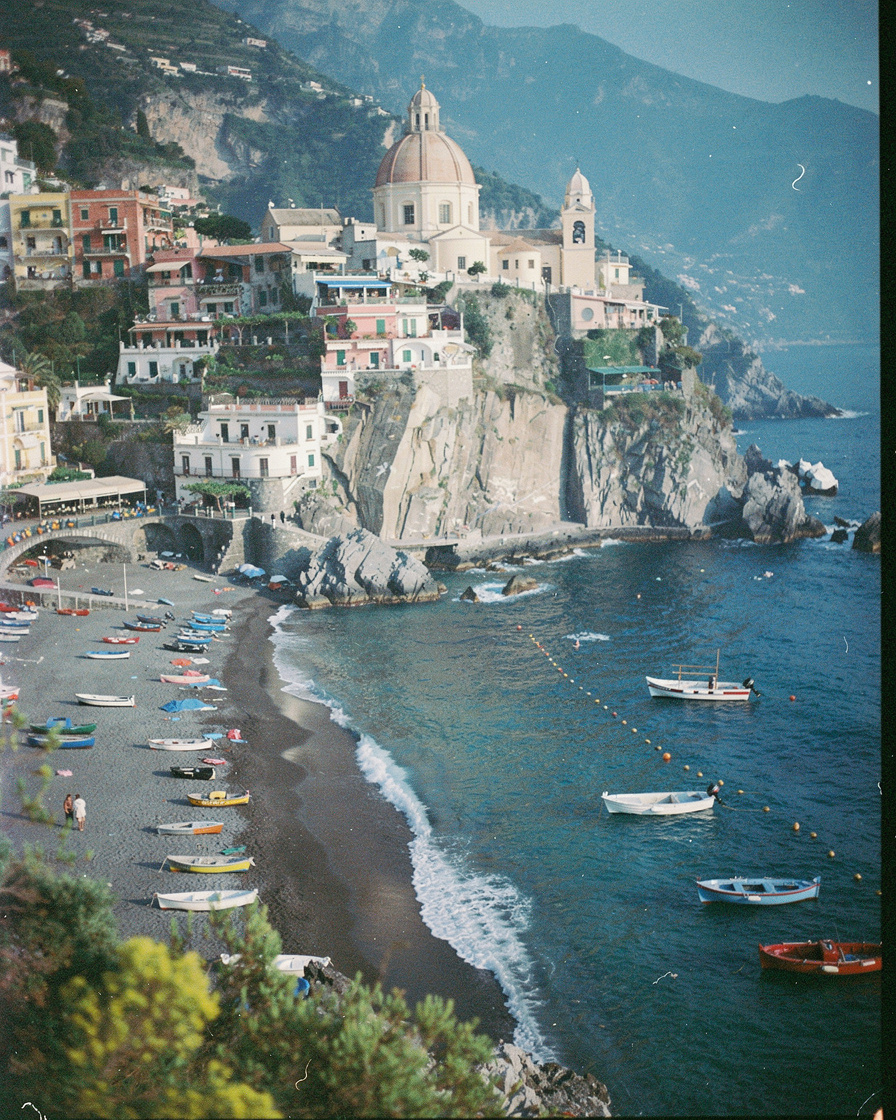
There is a specific hour in Positano when the town belongs to no one. Nine o'clock, maybe a few minutes past. The ferries haven't started yet. The rental umbrellas on the beach are still folded. The only company is the fishing boats pulled up on the pebbles, hulls faded to the color of old postcards. I loaded a fresh roll and sat on a wall still cool from the night.
The houses stack like they lost an argument with gravity. Terracotta, salmon, a faded yellow that my father would call giallo Napoli. Between them, stone staircases twist down toward the water, lined with bougainvillea so heavy it sags over the railings. I could hear someone's radio from an open window, something old and orchestral, and beneath it the small repeated sound of water pulling at the shore. No wind. The air smelled like salt and lemon trees and, faintly, bread from somewhere I couldn't see.
The dome of Santa Maria Assunta sat in the center of it all, its majolica tiles catching the sun in greens and yellows. I've seen photographs of it a thousand times. Everyone has. But there's a difference between the image and the weight of the thing. The tiles have a particular sheen at this angle, wet-looking even when dry. The camera noticed before I did. I took two frames. Maybe three. Sometimes the restraint is the photograph.
I think about my mother in moments like this. She grew up near the sea in Salvador, and she always said the ocean makes people honest because it doesn't care about you at all. Positano feels like that. Beautiful in a way that has nothing to do with your presence. You sit, you look, the light shifts across the cliff face, and no one is asking you for anything. Not even the town. It just keeps falling gently toward the water, the same way it has for centuries, and you either slow down enough to see it or you don't.